✅ The Most Important Investor Takeaways from Sasha Cooper’s Talk
🔹 The restaurant business in Ukraine today is not an “easy investment,” but an operationally complex business with high risk.
Cooper says directly that if he were a passive investor, he would not rush to invest in a restaurant without a strong operational team.
🔹 A normal ROI benchmark for a restaurant is 20–25% per year.
According to Cooper’s logic, if an investor wants a 25% annual return, the restaurant should pay back the investment in approximately 4 years. Anything with a payback period longer than 4 years he considers very risky because restaurant concepts usually have a short life cycle.
🔹 During a crisis, “non-obvious opportunities” appear.
According to him, restaurants that previously required $3–4 million in investment can sometimes now be bought for $500,000. This does not mean they should be bought automatically. But for a strong operator, it can be a chance to enter an asset at a major discount.
🔹 The main problem in the restaurant market is not only money, but people.
Cooper believes that the restaurant industry has built motivation incorrectly: waiters can often earn more than chefs and even managers, while talented people do not always have a clear path for growth.
🔹 The future belongs to new business models, not just cost-cutting.
In his opinion, most of the market will follow the path of “cutting costs and lowering quality.” He wants to move in another direction: shorter working hours, a simpler menu, a stronger product, fewer unnecessary processes, and more responsibility within the team.
🔹 The Ukrainian restaurant sector is still not a fully liquid business.
This is an important point for investors: a business is considered mature when it can be transparently bought and sold. Cooper believes that the Ukrainian restaurant industry has not yet reached this level because of shadow practices, weak systematization, and the lack of full capitalization.
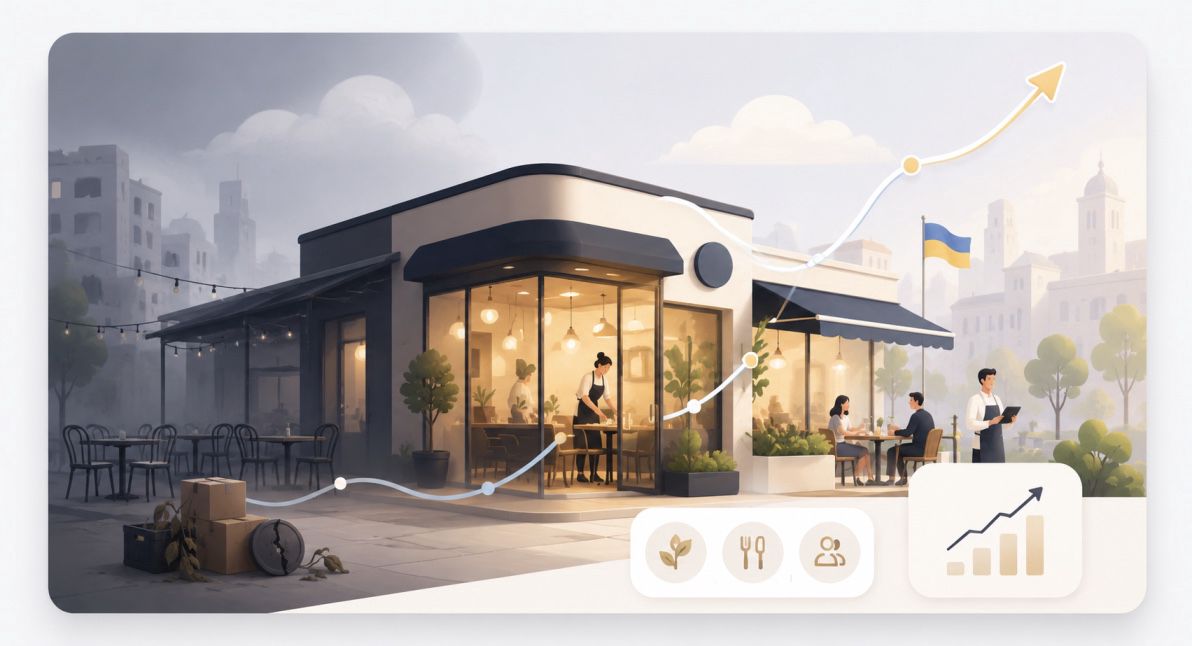
Ukraine’s restaurant business today looks like a market where two opposite things are happening at the same time.
On one side, it is a high-risk sector: foot traffic is under pressure, costs are rising, labor is scarce, and payback periods are harder to achieve. On the other side, crisis creates opportunities that almost never appear in normal times: strong locations become cheaper, experienced teams become more available, and expensive restaurant assets can sometimes be bought at a deep discount.
In his public talk, restaurateur Sasha Cooper made one point very clear: restaurant business in Ukraine is not just about opening a beautiful place. It is a complex operating system. An investor is not only investing in design, kitchen equipment, or a brand. The investor is investing in people, management, motivation, product, location, analytics, and the ability of the business model to survive pressure.
That is where the investment story becomes interesting. 💸
📉 Revenue May Grow, but Real Demand Can Still Be Weak
According to Poster, Ukrainian food service venues increased revenue by 6% in 2025, while foot traffic fell by 8% and the average check grew by 17%. In simple words, restaurants collected more money, but people did not necessarily visit more often. A large part of that revenue growth came from higher prices.
This is an important signal for investors. If a restaurant’s revenue is growing while guest traffic is falling, the investor has to look deeper. Is this real business growth, or is it only compensation for inflation, more expensive products, higher rent, higher wages, and energy costs?
Poster’s survey also shows that 42% of restaurateurs said their profitability decreased in 2025 compared with 2024. The most common profitability ranges were 5–10%, 15–20%, and 10–15%, while some businesses operated at zero or negative profitability.
In simple terms: a restaurant can have a beautiful interior, active social media, and many checks, but the investor’s main question is different — how much net profit remains after all expenses.
🧾 ROI: What Return Can Be Considered Healthy?
One of the most valuable parts of Cooper’s talk is his view on restaurant ROI.
He believes that a restaurant business should deliver around 20–25% annual ROI to the investor.
What does that mean in simple words?
If an investor puts $1 million into a restaurant, then at 25% ROI the business should generate around $250,000 in annual profit. That implies a payback period of roughly four years.
📌 The logic is simple:
➜ 25% annual ROI means around four years to pay back the investment.
➜ 20% annual ROI means around five years to pay back the investment.
➜ One to three years of payback is a very strong result for an individual restaurant project.
➜ More than four years of payback becomes a higher-risk zone because restaurant concepts can age quickly.
Cooper’s point is that if the average target is around four years, the portfolio must include projects that pay back faster — in one, two, or three years. Otherwise, the overall investment model becomes weak.
For an investor, this is a useful filter. If a restaurant project shows a six- or seven-year payback period, it requires tough questions: will the format survive that long, can rent increase, can the team leave, can traffic decline, and can the concept become outdated?
🧨 Labor Shortage Is the Risk Investors Often Underestimate
Cooper spent a lot of time talking about people. This may be the most important part of the entire discussion.
His core idea is that Ukraine’s restaurant industry used to behave as if strong people could always be found on the market. Now it is clear that this is not true.
The broader labor market confirms the issue. NV, citing Work.ua research, notes that the hotel and restaurant sector is among the industries most affected by the war, while 54% of surveyed companies plan to expand staff in 2026 despite labor shortages.
For a restaurant, this means one simple thing: even if there is money, a location, and a concept, the business does not work without people.
The problem is not only finding a cook, waiter, or manager. The deeper problem is building a system where talented and hardworking people can earn more, grow inside the company, and not leave for the same salary across the street.
Cooper criticizes a model where waiters can sometimes earn much more than kitchen staff or even managers. In his view, this destroys motivation because it does not create a fair career path.
For investors, this means that before investing in a restaurant, they should evaluate not only the menu and design, but also the HR model.
The due diligence questions should be direct:
➜ who runs the restaurant every day;
➜ how cooks, waiters, and managers are motivated;
➜ whether there is career growth;
➜ what staff turnover looks like;
➜ whether there is a strong internal team, not only a charismatic owner;
➜ what happens if the key chef or general manager leaves.
🍽️ Why “Cut Costs” Is Not Always the Right Strategy
According to Cooper, most of the market will take the simplest path during crisis: cut costs and lower quality. This is a logical reaction, but it can be dangerous.
If a restaurant saves money on product, people, service, and atmosphere, it can reduce costs for a while. But at the same time, it may lose the main reason why a guest returns.
Cooper proposes another logic: not simply cheaper, but different.
For example, one of the new formats he described is designed to work only a few hours per day and not seven days a week. The idea is not to satisfy every possible guest need from morning until night, but to create a specific product for a specific time.
This is a very important thought for wartime restaurant economics.
Instead of “we offer everything: pizza, sushi, hookah, breakfasts, cocktails, and banquets,” a restaurant can become more focused: one strong product, a clear time window, a clear guest, fewer unnecessary processes, and less operational chaos.
For investors, this means the future may belong not to the largest menus, but to the best-designed business models.
🏚️ Crisis as Opportunity: Cheap Assets, Strong Locations, Tired Owners
One of the most interesting parts of the talk is Cooper’s idea of “non-obvious opportunities.”
He gave an example of Odesa, where during the crisis it was possible to enter a strong location on unusually attractive terms. He also said that some restaurants that previously required $3–4 million of investment can now sometimes be bought for around $500,000.
For an investor, that sounds attractive. But there is a trap.
A cheap asset is not always a good investment.
If a restaurant is being sold at a deep discount, the investor has to understand why:
➜ weak location;
➜ weak concept;
➜ rent too high;
➜ high cost structure;
➜ tired team;
➜ wrong format;
➜ no recurring guests;
➜ debt or legal risks.
But if the problem is not the location, but management, then a strong operator may have an opportunity. Especially if the format can be relaunched, the menu improved, unnecessary costs removed, the team rebuilt, and guests brought back.
This is where restaurant investment starts to look like distressed assets — buying assets that became cheaper because of crisis, but can regain value under better management.
📊 The Big Weakness of the Restaurant Market: Poor Analytics
Cooper was also very direct about another issue: many restaurants do not really know their guests.
Many venues spend money on social media, targeting, decoration, and promotional activities, but do not have answers to basic questions:
➜ how many guests return;
➜ how many guests are new;
➜ which channels actually bring people;
➜ what share of customers are regular guests;
➜ what happens after the first visit;
➜ how much it costs to acquire one guest.
This matters a lot for investors. Without these metrics, a restaurant is less like a managed business and more like a beautiful project run by intuition.
In a mature business, the owner should understand not only “we like this location,” but also traffic, repeat visits, average check, margins, food cost, payroll, seat utilization, seasonality, and the payback of every marketing channel.
Until that happens, the restaurant business remains highly dependent on the owner’s intuition.
🌾 Vertical Integration: Restaurants, Farms, Processing, and Own Product
Another strategic topic in Cooper’s talk is his ambition to build an internal product pool: grow food, process it, and use it inside his own restaurants.
This is no longer the classic model of “rent a space and open a restaurant.” It is an attempt to build a longer value chain:
🌱 grow the product;
🏭 process it;
🍽️ use it in owned restaurants;
🛒 potentially sell it through retail networks;
🏺 add related directions, such as ceramics for the restaurant ecosystem.
For investors, this is interesting because it can create not only restaurant profit, but also capitalization around brand, product, land, production, and distribution.
But this is also a more difficult path. It requires more time, stronger management, and more patience.
🇺🇦 Ukrainian Cuisine: Patriotism Alone Does Not Guarantee Commercial Success
Another honest point from the talk: Ukrainian cuisine does not automatically sell better just because it is Ukrainian.
Cooper explains that guests often perceive a restaurant not only through food, but through the whole experience: place, atmosphere, fountain, park, sofas, and the feeling of time well spent. People do not come only to “eat borshch.” They come for emotion.
This is important for anyone planning to open a restaurant.
A strong product is necessary. But a restaurant sells more than food. It sells the full experience: location, service, design, music, lighting, seating, story, comfort, and a reason to return.
A Ukrainian concept can be successful if it is not only “about Ukrainian cuisine,” but about a strong experience, local story, high-quality product, and a clear business model.
🚀 What a Beginner Should Understand Before Opening a Restaurant
The main advice from Cooper’s talk is simple: do not start with the phrase “I want to enter a niche.”
Start with the product.
Not “I will open a venue,” but:
➜ what dish can I make better than others;
➜ why should the guest return;
➜ what format can I realistically operate;
➜ how many people are needed;
➜ what is the margin;
➜ what is the payback period;
➜ who will manage the business daily;
➜ what do I do better than competitors.
Cooper gives a simple example: a bakery can be easier to understand than a bar because a bakery has a concrete product. A bun can be tested, compared, and improved. But “bar atmosphere” is harder to measure because it works almost magically.
For a beginner, this means the more specific the product is, the easier it is to improve.
🔮 What May Happen Next in Ukraine’s Restaurant Market
Scenario 1. Weak players close, strong operators buy assets
If pressure on costs, labor, and traffic continues, some restaurants will not survive. For strong operators, this may create opportunities to buy locations, equipment, or stakes in businesses at a discount.
Scenario 2. The market moves toward simpler formats
More restaurants may reduce menu size, working hours, and staff count. Formats with simple operations and a clear product may win.
Scenario 3. Quality may fall if operators only cut costs
If most businesses only reduce expenses, guests will receive weaker food and service. This opens space for operators who can preserve quality while building a more efficient model.
Scenario 4. Data and CRM become a competitive advantage
Restaurants that learn to track returning guests, repeat visits, advertising efficiency, and real margins will have an advantage over those working only by intuition.
Scenario 5. The market may slowly become more investable
If Ukraine’s restaurant business becomes more transparent and liquid, more systematic investors may enter the sector. But this will not happen quickly. It requires transparent reporting, clear agreements, legal payroll, and the ability to buy and sell stakes.
🧠 Investor Takeaway
Restaurant business during war is not a simple story about opening a beautiful place and waiting for profit.
It is a business where profitability depends on dozens of details: team, motivation, location, product, pricing, costs, analytics, rent, energy resilience, and the owner’s ability to change the model quickly.
For a passive investor, a restaurant can be a dangerous asset. But for an investor with a strong operator, a clear understanding of risks, and the ability to enter an asset at a discount, today’s market may create rare opportunities.
The main point is simple: do not buy a “beautiful restaurant.”
Invest in a system that can survive crisis and remain profitable. 💼