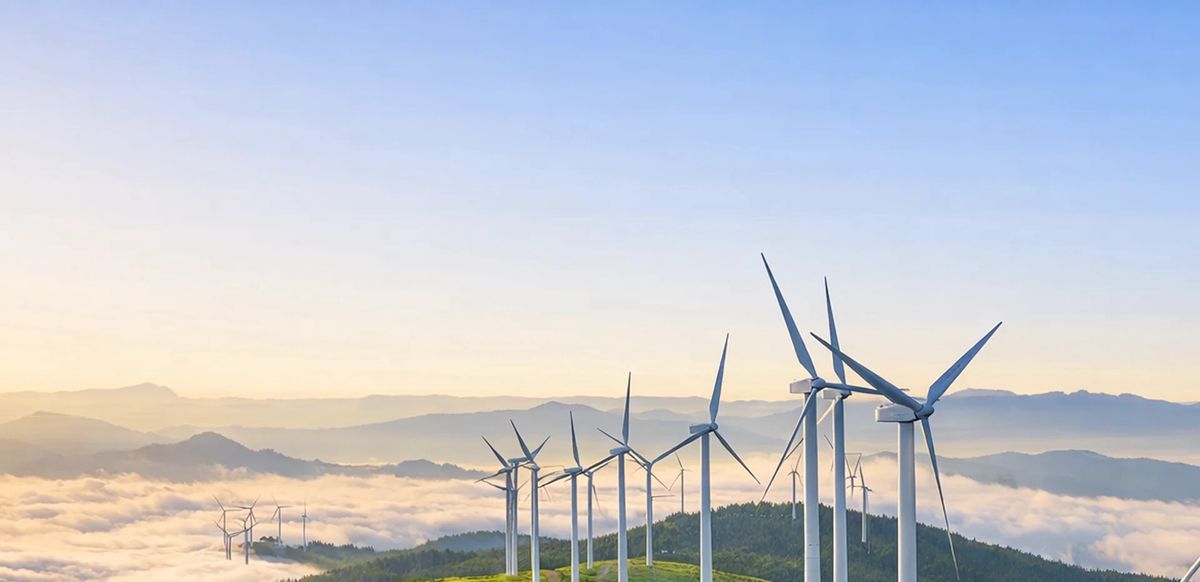
Ukrainian private investors are now being offered the opportunity to invest in wind energy with an entry threshold of approximately UAH 125,000. The Varto platform has opened access to purchasing an economic stake in two operating wind turbines of the “Nyzhni Vorota-3” project in Zakarpattia Oblast.
Investors are offered a projected return of 11–13% per year in euros, with quarterly payouts, while the investment horizon is 11 years. The project plans to raise approximately UAH 590 million in total.
📌 In simple terms: the investor does not directly buy “a piece of a wind turbine.” Instead, the investor purchases investment certificates of a fund, which is expected to hold a stake in the energy asset.
🧩 Product
Varto offers private investors participation in an operating energy asset — two wind turbines of the “Nyzhni Vorota-3” project.
This is not a greenfield construction project. The turbines are already:
✅ built;
✅ connected to Ukraine’s power grid;
✅ generating electricity;
✅ selling electricity on the market.
The investor purchases investment certificates of the Closed Qualified Real Estate Investment Fund “Real Estate Growth Fund”. Through this fund, the investor receives economic exposure to the project.
According to the declared structure, the fund is expected to hold 49% ownership rights in the wind turbines, while the operator/owner of the remaining stake is responsible for operating the asset.
💶 Return and Payouts
The declared return for investors is:
✅ 11–13% per year in euros;
✅ payouts — quarterly;
✅ investment horizon — 11 years.
The return is expected to be generated from two main sources:
⚡ regular income from the sale of electricity;
🏁 final income from the sale of the asset after the project is completed.
📌 In simple terms: the wind turbines generate electricity, the electricity is sold, and part of the income should be paid to investors.
⚠️ Important: 11–13% per year is a projected return, not a bank guarantee. The actual result depends on asset performance, electricity prices, operating costs, contractual terms, and the final sale of the asset.
🛡️ Income Guarantee
Varto’s materials state a minimum guaranteed return of 5% per year.
However, investors should critically verify:
🔍 who exactly guarantees this 5%;
🔍 which agreement secures this obligation;
🔍 whether the guarantee is backed by collateral or other security;
🔍 what happens if the operator cannot make payments;
🔍 whether the guarantee applies in the event of war, accidents, turbine damage, or generation shutdowns.
📌 In simple terms: 5% may be a contractual obligation, but it is not the same as a government or bank guarantee.
💰 Minimum Entry Threshold
The minimum entry threshold is approximately:
✅ from UAH 125,000–126,000;
✅ minimum package — around 122 investment certificates.
This makes the project accessible to retail investors who previously had almost no direct access to similar infrastructure assets.
⏳ Minimum Investment Term
The basic investment horizon is 11 years.
This means the project should not be viewed as a short-term investment instrument.
⚠️ Main risk: the investor may not have a simple way to exit the project quickly or sell the certificates without a discount.
📌 In simple terms: the money may be “locked up” for a long period, so investing funds that may be needed in the coming years is risky.
📍 Key Location
The project is located in Zakarpattia Oblast, in the area of Nyzhni Vorota / Verkhni Vorota, Mukachevo District.
Location advantages:
✅ Zakarpattia is far from the front line;
✅ the region has wind potential;
✅ the asset is already connected to the power grid;
✅ the asset is operating and generating electricity.
Potential location risks:
⚠️ the Carpathian region is environmentally sensitive;
⚠️ wind farms in the Carpathians face criticism from environmental activists and part of the public;
⚠️ reputational and regulatory risks may arise if public opposition increases.
🏢 Who Is Behind the Project
The platform operator is Marketplace Investments LLC.
In Varto’s public materials, the following team members are listed:
👤 Rostyslav Kulchykovskyi — general management and finance;
👤 Anna Shveda — marketing and PR;
👤 Dmytro Ovsii — legal affairs.
Open media sources also link the project to a business group active in energy assets, including wind energy.
📌 For an investor, it is important not to rely only on the platform’s brand, but to review the entire structure: the fund, asset management company, operator, asset owner, contracts between the parties, and financial obligations.
🏗️ How Investor Funds Will Be Used
The declared model provides that investor funds will be directed through the fund toward acquiring a stake in already operating wind turbines.
This means the funds should be used not for construction from scratch, but for purchasing a stake in an asset that is already functioning.
Positive aspect:
✅ lower risk of unfinished construction;
✅ the asset already generates electricity;
✅ actual generation and operating performance can be analyzed.
What should be checked:
🔍 whether the fund actually acquires ownership rights to a stake in the asset;
🔍 whether the ownership is legally documented correctly;
🔍 whether the funds are not being used for other needs of the group;
🔍 what fees and expenses are deducted from investor funds.
💸 How Interest Will Be Paid to Investors
Investor payouts are declared to be quarterly.
The source of payouts should be income from the sale of electricity.
The amount of payouts may depend on:
⚡ volume of electricity generated;
🌬️ wind strength and stability;
🛠️ technical condition of the turbines;
📉 market price of electricity;
💶 exchange rate;
📑 taxes, fees, and operating expenses;
⚖️ contractual terms between the fund and the operator.
📌 In simple terms: if the turbines operate well, electricity is sold at favorable prices, and costs are controlled, returns may be closer to the declared level. If conditions deteriorate, payouts may be lower.
🔁 How the Investment Principal Will Be Returned
The main mechanism for returning the investment principal is an exit after 11 years.
After the investment period ends, the asset should be sold or bought back, and the proceeds should be distributed among investors.
Key questions to verify:
🔍 who exactly is obligated to buy back the asset;
🔍 what formula determines the buyback price;
🔍 whether there is a notarized agreement or other legal security;
🔍 what happens if the operator does not have enough money for the buyback;
🔍 whether the fund can sell its stake to another buyer;
🔍 what happens if the asset value after 11 years is lower than expected.
⚠️ Main risk: if the asset cannot be sold at the expected price, the investor may receive less than the financial model assumes.
⚖️ What Agreement Regulates Relations with the Investor
Relations with the investor are regulated through the mechanism of investment certificates of the fund.
The project structure includes:
🏦 Closed Qualified Real Estate Investment Fund “Real Estate Growth Fund”;
🏢 AMC Portofin LLC — the asset management company;
📄 investment certificates — securities purchased by the investor.
An investment certificate confirms the investor’s right to a share in the fund’s assets and income from them in accordance with the fund’s documents.
Before investing, the investor should review:
📄 issuance prospectus;
📄 fund regulations;
📄 certificate purchase agreement;
📄 documents confirming the fund’s rights to a stake in the turbines;
📄 agreement with the operator;
📄 terms of the minimum guaranteed return;
📄 exit mechanism after 11 years.
🏛️ Legal Support
A positive feature of the project is that it is structured not as a simple “loan to a company,” but through an investment fund and securities.
This creates a more formalized legal structure.
✅ the investor purchases securities;
✅ accounting should be conducted through capital market infrastructure;
✅ the fund has regulations and an issuance prospectus;
✅ the asset management company manages the fund’s assets.
However, the legal structure is also complex. Therefore, the investor should understand that investor rights depend not only on the Varto platform, but also on the fund, the asset management company, the operator, the depository infrastructure, and all contracts between the parties.
🧾 Restoration and Protection of Ownership Rights
In this project, the investor’s right should be confirmed not by physical ownership of part of a wind turbine, but by investment certificates.
That means the investor owns securities, while the fund owns a stake in the asset.
What is important to verify:
🔍 whether the certificates are properly recorded;
🔍 whether the fund actually holds a stake in the wind turbines;
🔍 whether there are any encumbrances, pledges, or disputes over the asset;
🔍 how the investor can confirm their rights;
🔍 what happens in case of liquidation of the fund, the asset management company, or problems with the operator.
📌 In simple terms: the investor should make sure that their right is not merely “shown in an online account,” but legally confirmed by securities and fund documents.
📊 Market and Investment Rationale
Ukraine has a significant need for new electricity generation sources. Due to the war, the country’s energy infrastructure has suffered substantial damage, so demand for electricity and new generation capacity remains high.
Wind energy may be a promising sector, especially if the asset:
✅ is already built;
✅ has grid connection;
✅ has stable generation;
✅ sells electricity on the market;
✅ has professional technical maintenance.
However, a return of 11–13% per year in euros is high for an infrastructure asset. Such a level of return usually indicates elevated risks.
🔴 Criticism and Potential Risks of Losing Funds
🔴 1. Risk of Lower Actual Return
The declared 11–13% per year in euros may not be achieved.
Possible reasons:
⚠️ weaker wind conditions;
⚠️ lower electricity prices;
⚠️ turbine downtime;
⚠️ repairs;
⚠️ rising costs;
⚠️ changes in tax or market rules.
🔴 2. Liquidity Risk
The project horizon is 11 years.
This means the investor may not be able to withdraw funds quickly.
⚠️ It may be difficult to sell investment certificates.
⚠️ The secondary market may be limited.
⚠️ Early exit may require selling at a discount.
🔴 3. Operator Risk
The fund owns a stake in the asset, but day-to-day turbine operations depend on the operator.
The operator is responsible for:
🛠️ technical maintenance;
⚡ generation;
💸 electricity sales;
📑 contract performance;
🔁 potential buyback of the asset.
If the operator faces financial, legal, or technical problems, this may directly affect investor income.
🔴 4. Final Buyback Risk
The return of the investment principal largely depends on the sale or buyback of the asset after 11 years.
Problems may arise if:
⚠️ the operator cannot buy back the asset;
⚠️ the asset is worth less than expected;
⚠️ there is no alternative buyer;
⚠️ the equipment depreciates faster than assumed in the model.
🔴 5. Regulatory Risk
Ukraine’s electricity market is regulated.
Returns may be affected by:
⚖️ changes in electricity market rules;
⚖️ tax changes;
⚖️ restrictions or new requirements for producers;
⚖️ changes in investment fund regulations.
🔴 6. War Risk
Although Zakarpattia is located far from the front line, Ukraine remains a country at war.
Risks include:
⚠️ damage to energy infrastructure;
⚠️ restrictions on grid operation;
⚠️ disruptions in repairs and logistics;
⚠️ changes in state regulation due to martial law.
🔴 7. Technical Risk
Wind turbines are complex industrial equipment.
Possible issues include:
🛠️ accidents;
🛠️ equipment wear;
🛠️ expensive repairs;
🛠️ downtime;
🛠️ shortage of spare parts.
Even if the asset is new or recently commissioned, technical risk does not disappear completely.
🔴 8. Environmental and Reputational Risk
Wind energy projects in the Carpathians have triggered debate among environmentalists, activists, and local communities.
Key concerns include:
🌲 impact on landscapes;
🦅 impact on birds and bats;
🏔️ impact on natural areas;
👥 attitude of local communities;
📑 quality of environmental procedures.
Even if the specific asset is already operating, environmental criticism may affect the project’s reputation and future regulatory decisions.
✅ Strengths of the Project
The project has several important advantages:
✅ the asset is already operating;
✅ the investment is linked to real electricity generation;
✅ Ukraine’s electricity market has strong demand;
✅ the structure is organized through an investment fund;
✅ access is available to retail investors;
✅ the entry threshold is much lower than direct acquisition of an energy asset;
✅ payouts are declared to be quarterly;
✅ returns are denominated in euros.
⚠️ What Must Be Checked Before Investing
Before making an investment decision, the following should be requested and analyzed:
📄 fund issuance prospectus;
📄 fund regulations;
📄 confirmation of the fund’s right to 49% of the asset;
📄 agreement with the operator;
📄 terms of the 5% minimum guaranteed return;
📄 final asset buyback formula;
📄 notarized agreements related to the exit;
📄 turbine insurance;
📄 actual generation data for recent months;
📄 financial model;
📄 fees of the asset management company, broker, depository, and platform;
📄 litigation history;
📄 environmental permits and environmental impact assessment documents.
🧠 Critical View of the Project
The project appears interesting as one of Ukraine’s first formats that gives private investors access to an operating energy asset through a fund structure.
Its strong point is the presence of a real asset that already generates electricity. This distinguishes it from many investment offers where funds are raised at an early construction stage or for a business idea.
At the same time, the project should not be viewed as risk-free. A return of 11–13% per year in euros is attractive, but such a rate itself indicates elevated risks.
The most important risks are:
🔴 long term — 11 years;
🔴 low liquidity;
🔴 dependence on the operator;
🔴 uncertainty of the final buyback;
🔴 technical risks;
🔴 war-related risks;
🔴 regulatory risks;
🔴 environmental criticism of wind farms in the Carpathians.
📌 In simple terms: this may be an interesting instrument for part of a long-term portfolio, but it is not a replacement for a bank deposit and not a suitable option for investing one’s last available funds.
🏁 Conclusion on Investment Attractiveness
Investment in the wind turbines of the “Nyzhni Vorota-3” project through the Varto platform has a clear business logic: an operating asset generates electricity, electricity is sold, and income should be distributed among investors.
The project has several positive characteristics: an operating asset, fund structure, accessible entry threshold, quarterly payouts, and exposure to the energy sector, which is strategically important for Ukraine.
At the same time, the declared return of 11–13% per year in euros should not be perceived as a guaranteed result. Actual profitability will depend on turbine performance, electricity prices, costs, contracts, operator actions, and the final sale of the asset.
✅ The project may be interesting for investors who are ready to accept long-term risk.
⚠️ The project is not suitable for investors seeking full capital protection or quick access to their money.
📞 Contact Details of the Investment Project
Platform: Varto
Operator: Marketplace Investments LLC
Manager: Rostyslav Kulchykovskyi
Address: 28/12 Verkhnii Val St., Office 305, Kyiv, 04071, Ukraine
E-mail: info@varto.investments
Phone: +38 (044) 290 73 30
Website: varto.investments