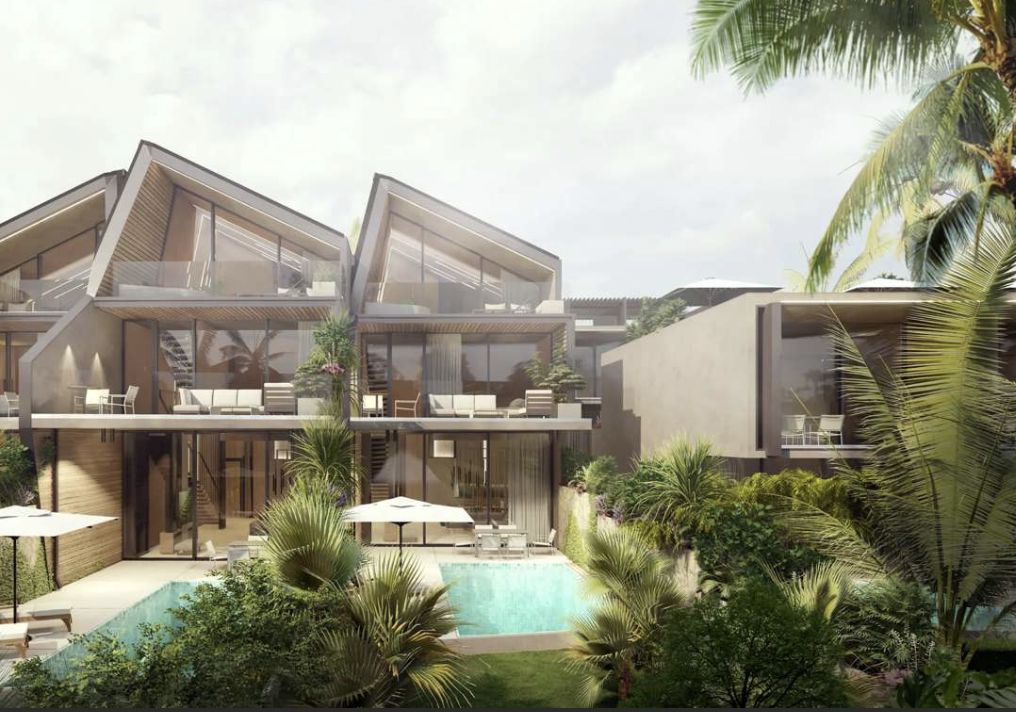
Avalon × Ready to Fight by Oleksandr Usyk is marketed as a premium Bali real estate investment product built around branded hospitality, wellness, service, and a sports-driven lifestyle concept. Public materials connect the project to Avalon Bali Group, Ready to Fight, and Ribas Hotels Group, while Legion’s landing page promotes the offer with +30% capital growth, 12% annual yield, and management by Ribas Hotels Group.
Key investor terms 💰
According to Legion’s Telegram materials, one public offer for Avalon × Ready to Fight listed prices starting from $118,078 with 100% payment, $124,638 with 50% payment, and $132,300 with 30% payment, alongside 12% annual ROI, +30% appreciation during construction, and 32+30 year leasehold.
However, the official Avalon project pages show different numbers. The BUDDHA page lists from $107,000, projected ROI 15%, 85% occupancy, 130 apartments, 32+32 year leasehold, and completion in 2027. The TAO page lists from $65,000, projected ROI 16%, 129 apartments, 25+25 year leasehold, and completion in 2027. This means the public investor-facing data is not fully consistent across sources.
How exactly is Usyk involved? 🥊
Based on the public materials, Oleksandr Usyk’s role appears to be strategic, branding-led, and conceptual, not technical construction management. Avalon states that the partnership includes the integration of Usyk Gym into a flagship Bali project, while Legion describes the concept as Performance Living, meaning Usyk’s training philosophy translated into architecture and lifestyle design.
Just as importantly, I did not find public evidence showing that Usyk is the developer, landowner, operating manager, contractor, or legal guarantor of investor payments. In the public structure, Avalon appears to handle development, Ribas handles operations and hotel management, and Ready to Fight / Usyk adds brand power, concept, and market visibility. For investors, that distinction matters a lot: celebrity involvement is not the same as a legal guarantee.
How are investor payouts supposed to work? 📈
The official BUDDHA and TAO pages describe a similar flow: apartment selection, Memorandum of Understanding, first installment, interest-free installments until construction completion, then rental operations, tenant attraction through the in-house management company, and quarterly profit payouts to investors. The pages also mention notarial registration of the lease agreement with an extension option. In simple terms, the public model is based on recurring rental income after launch, not a one-time final payout.
But there is an important wording issue. Legion’s landing page uses the language of “guaranteed passive income,” while Ribas’ own article describes projected operating profitability of 12–14% per annum from year three. That is a meaningful difference. Unless the contract contains a strict guarantee with clear liability, investors should treat the public “guaranteed income” claim with caution.
How does the investor recover the principal? 🧾
I did not find a clearly disclosed public buyback mechanism or a fixed-date principal repayment commitment. Instead, Avalon emphasizes two standard real estate exit routes: holding the unit for rental income or reselling at a profit at any stage as the project develops. That means capital recovery appears to depend on resale or continued operation, not on a guaranteed repurchase by the developer.
Which agreements govern the investor relationship? ⚖️
Publicly, Avalon describes the process as starting with an MoU and later moving to notarial registration of the leasehold agreement with an extension option. The BUDDHA and TAO pages also state that full legal support is included in the price. That is a positive service promise, but investors still need to verify the core legal points independently: land title structure, the exact leasehold wording, renewal mechanics, delay liability, and payout terms.
Bali market reality — strong demand, but not a risk-free story 🌴
Bali’s demand story is real. Official BPS Bali data shows 6,948,754 direct foreign arrivals in 2025, up 9.72% versus 2024. That supports the broad investment case for the island.
Still, island-wide occupancy is more uneven than many sales decks suggest. Official BPS data for star-rated hotels shows 46.61% occupancy in March 2025, 64.66% in June, 69.54% in August, 64.57% in October, and 60.88% in December. So while an individual best-in-class project may outperform, “80–85% occupancy even off-season” should be treated as an aggressive case, not as the baseline market norm.
Competition is another serious issue. Horwath HTL and C9 Hotelworks report that, as of March 2025, Bali’s hospitality-managed residence market had 59 projects and 3,643 units, with Canggu/Berawa accounting for 39% of total supply. The same report warns about heavy development pressure, limited market access for many operators, rate pressure, infrastructure bottlenecks, and ends with a blunt message: buyer beware.
Legal risks for foreign investors 📑
For foreign investors, the legal structure is one of the biggest risk areas. Cekindo notes that foreigners cannot directly own Hak Milik land and typically rely on Hak Pakai, Hak Sewa, or PT PMA structures. Horwath also notes that leasehold has historically been a limiting factor for Bali buyers, with market-standard terms often falling into the 25–35 year range. Your PDF adds a practical warning: leasehold renewal may be possible, but it depends on the contract and may require additional payment. In plain English, what matters is not the marketing headline but the exact legal wording in the signed documents.
Regulatory uncertainty 🚧
Reuters reported in 2024 that Bali authorities were considering a moratorium on new hotels, villas, and nightclubs in heavily built-up areas because of overdevelopment, traffic, and pressure on the island. In January 2025, Skift reported that the governor stepped back from a blanket ban but promised stricter controls instead. For investors, this shows that Bali’s regulatory environment is active and can shift as the island tries to manage overtourism and construction pressure.
What about reviews and public feedback? 💬
I did not find a strong body of independent, verified investor reviews specifically for Avalon × Ready to Fight. Search results are dominated by official company websites, partner pages, social media content, and promotional materials, rather than independent post-investment case studies or a large archive of complaints. That does not prove the project is weak, but it does mean the public narrative is currently driven more by marketing than by long-term performance evidence for this exact product.
I did find a few positive public comments about Legion Real Estate on forums and review sites, but that is still not enough to replace proper due diligence. For a serious investor, contract quality, land documents, construction progress, operator reporting, and previous project execution matter much more than scattered online praise.
Main criticism — where investors could lose money ❗
The biggest red flags are clear. First, there are inconsistencies across public materials: pricing, apartment count, leasehold term, and return language do not fully match from source to source. Second, Usyk’s name adds major branding power, but branding is not a legal guarantee. Third, Canggu/Berawa is attractive but already crowded, which raises competition risk. Fourth, leasehold is still leasehold, not permanent ownership. Fifth, the gap between sales-deck occupancy assumptions and official island-wide hotel occupancy data means actual returns may end up lower than advertised if execution is average rather than exceptional.
Final investor view 🧠
This project does not look like empty hype: there are real companies, a real market, a real operating partner, and a product logic that fits Bali’s branded hospitality trend. But it also does not look risk-free. The most honest view is that this is an interesting but execution-sensitive Bali investment, where the main danger is buying the story before verifying the structure. If the contract, land documents, payout model, and final unit list all align clearly, the project may make sense for an investor who accepts Bali risk. If the numbers continue to shift between the landing page, Telegram materials, and partner articles, caution is justified.
Project contacts 📞
Legion Real Estate / project landing page:
+62 (89) 500-197-6098
+62 (89) 500-197-6144
Avalon Bali Group:
WhatsApp: +62 (812) 4650-27-83
Email: mail@avalonbali.com
Address: Jl. Raya Semat No.99x, Kabupaten Badung, Bali 80361
Ribas Hotels Group:
+38 (097) 842-08-34
Email: hello@ribashotels.com