Here is an update on Inzhur over the last two years — in simple language, with pros, cons, and a conclusion for an investor.
In short: as of April 2026, Inzhur looks like a living and growing investment project, not a “dead story”: the company expanded the number of investors, merged 5 funds into the large Inzhur REIT, actively promotes its commercial real estate direction, is also developing Inzhur Energy, and sells Ukrainian government bonds (OVDP) through its platform. But there are also important risks: certificate liquidity, dependence on asset valuation, legal disputes in the energy segment, and wartime risks for real estate and construction. (inzhur.reit)
🏢 What happened with them in 2024–2026
During this period, Inzhur did not shrink — on the contrary, it scaled up. On its “About Inzhur” page, the company shows 69,294 active accounts. Separately, the new Inzhur REIT fund page shows 60,812 co-owners, 17 properties, UAH 5.18 billion in asset value, UAH 666.4 million in dividends paid, and an actual return over the last 12 months of 12.96% in USD. This is the main signal that the platform is not standing still, but is truly growing in scale. (inzhur.reit)
In 2025, Inzhur made a very important structural change: five funds were consolidated into one large fund, Inzhur REIT. This is not just a company statement — it was confirmed by the regulator. Ukraine’s National Securities and Stock Market Commission officially reported that it approved a pilot project to merge the assets of five funds into one investment fund, “INZHUR REIT,” and also gave investors a legally fixed right to submit certificate redemption requests until April 4, 2026. For an investor, this means two things: first, Inzhur managed to complete a complex regulatory operation; second, the regulator recognized the need to protect investors through a separate redemption mechanism. (nssmc.gov.ua)
Inzhur also strengthened its licensing position: in August 2025, the National Securities and Stock Market Commission granted Inzhur Capital LLC a dealer activity license in the capital markets. This is a plus in terms of formal legal infrastructure. But the fact of having a license does not remove investment risk — it only shows that the company operates within the legal framework of the capital market. (nssmc.gov.ua)
🧱 How they are doing across different business directions
1) Commercial Real Estate / Inzhur REIT
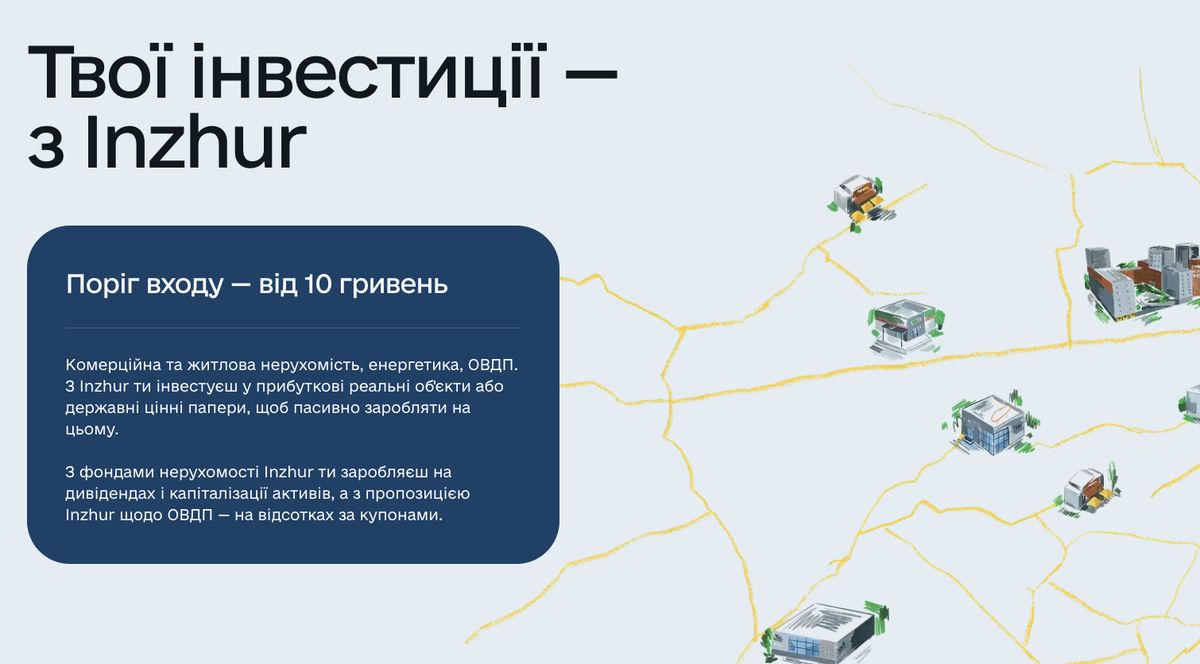
This is currently their main and strongest direction. The new REIT fund declares a portfolio with several types of assets: properties leased to Silpo, Fora, Comfy, MasterZoo, properties leased to McDonald’s, Sky Park shopping mall in Vinnytsia, as well as a retail park project and the “Svidomi” residential complex in Kriukivshchyna. In other words, the model is no longer about one specific store or restaurant, but about a large diversified portfolio. (inzhur.reit)
By the numbers, this direction currently looks the most convincing: Inzhur REIT declares a projected return from 9.5% annually in USD, and an actual return over the last 12 months of 12.96% in USD. Investor income here consists of monthly dividends plus growth in property value. The minimum entry point is from 1 certificate with a nominal value of UAH 10, and purchases are made at NAV + 1%. (inzhur.reit)
What this means in practice: Inzhur significantly lowered the entry threshold and made the product accessible to the mass market. This is likely one of the reasons for the sharp growth in the number of clients in 2025. But this is also where one of the main risks lies: when the entry is very easy, many investors may not fully understand that they are buying not a “deposit,” but illiquid fund certificates tied to real assets and their valuation. (inzhur.reit)
2) Energy / Inzhur Energy
This is a riskier, but potentially more profitable direction. On the Inzhur Energy page, the company describes the construction of a 34 MW gas piston power plant. The minimum investment is 1 certificate from UAH 6,000, the projected return is 15% annually in USD, and the profit model is without dividends, only through capitalization / revaluation of the certificate value. The current fund term runs until June 28, 2029. (inzhur.reit)
There have already been serious issues here. Forbes reported that construction of the power plant in Sofiivska Borshchahivka started in November 2024, but in 2025 it was suspended by a court decision; part of the local community opposed the project, and prosecutors referred to alleged violations of urban planning regulations. Later, some or all of the restrictions were lifted by the courts, and in March 2026 Forbes reported that the Supreme Court allowed Inzhur to resume construction. This is important for an investor: the project did not “die,” but it did go through a very real legal conflict. (forbes.ua)
My conclusion on Energy: this direction does not look fake, because the distributed generation market in Ukraine is genuinely growing — the Ministry of Energy reported that in 2025, 762 MW of new gas generation was commissioned, and the state expects further expansion. But this fund clearly has higher execution risk, because profit depends not on already operating rental income, but on project completion, legal stability, grid connection, contracts, and operational delivery. (mev.gov.ua)
3) OVDP / Ukrainian Government Bonds
This is their lowest-risk direction in terms of credit risk, because these are Ukrainian government bonds, where the state guarantees repayment of principal and yield. Inzhur presents this product as a short-term alternative to a bank deposit, with a return of up to 16.5% in UAH and an entry point of from 1 bond. (inzhur.reit)
In essence, OVDP through Inzhur is not their “unique business,” but rather a convenient distribution channel for government securities. For an investor, this can be useful, but this product should be evaluated separately from REIT and Energy.
💬 What reviews exist about them
There are positive reviews, but they should not be treated as a full audit. On Minfin, there is a positive review in which a user praises the low entry threshold, Telegram community, account interface, and support. On Reddit, there is also a user who says they have been investing since 2024, have a significant amount in their portfolio, and that dividends are paid consistently. This is a good signal, but these are still unofficial, unverified user opinions. (minfin.com.ua)
There are also negative reviews and criticism. On Reddit, users directly write that the promised returns, especially in older individual funds such as Ocean, seem “unrealistically high.” On DOU, there was earlier criticism in the sense that a private fund means lower transparency and higher distrust compared with classic public REITs traded on stock exchanges. In March 2026, Minfin in its article separately emphasized that for real estate funds in Ukraine, liquidity is one of the key risks, and the advertised returns of 10–14% require very careful recalculation. (reddit.com)
There is also another type of negative feedback — not from investors, but from employees. On DOU, there is a negative review about the company’s internal work organization. For an investor, this is not direct evidence of problems with payments, but it can be an indirect marker of how well internal processes are built. At the same time, there is also a positive employee review on DOU about a comfortable work atmosphere. So the overall picture is mixed. (jobs.dou.ua)
⚠️ Main criticism: how an investor could lose money
The most important issue is liquidity risk. Inzhur certificates are not exchange-traded instruments comparable to public American REITs with a deep secondary market. Yes, in 2026 the company introduced a minimal spread: purchases of REIT and Energy go at NAV + 1%, and sales at NAV, but this does not automatically make the instrument highly liquid. If the market cools down or the inflow of new investors slows, it may become harder to exit a position than to enter it. (inzhur.reit)
Second is asset valuation risk. Fund returns are partly based on the revaluation of property and certificates. This is normal practice for funds, but in a crisis or wartime environment, commercial real estate valuation can be very sensitive. If assets are overvalued, or if the market declines, investors will feel it. This is especially important in the Energy fund, where there are no dividends and the whole profit logic depends on capitalization. (inzhur.reit)
Third is wartime and operational risk. Inzhur invests in Ukrainian commercial real estate and energy during wartime. For shopping malls, retail, and restaurants, this means the risk of lower foot traffic, interruptions caused by air raid alerts, and pressure on tenants. For example, UTG estimated average vacancy in Kyiv shopping malls at 12.8% by the end of 2025 and warned that new supply could put pressure on the market. So the market is alive, but not problem-free. (interfax.com.ua)
Fourth is construction and permitting risk. This is most clearly seen in Inzhur Energy: the project was already suspended by a court. For the assets still under development within REIT, there is also a risk of delays, cost increases, tenant changes, or postponed launch dates. (forbes.ua)
📈 Does their promised return look realistic
For the REIT direction, the target of 9.5% in USD does not look фантастично if the assets are truly operating, tenants are paying, and occupancy remains stable. Moreover, Inzhur itself reports an actual return over the last 12 months of 12.96% in USD. But this does not mean that such a level is guaranteed going forward. Part of the result may be due to successful deals, asset revaluation, and a special growth period after the fund consolidation. (inzhur.reit)
For Energy, the promise of 15% in USD is more aggressive. Given that the distributed generation market is actually growing, this is theoretically possible, but here everything depends much more on project execution, court decisions, connection to the grid, tariff model, and management quality. I would describe this direction as real, but high-risk, rather than “reliable passive income.” (inzhur.reit)
🧭 What is their overall situation now
My honest conclusion is this: Inzhur currently does not look like a troubled or fading project. On the contrary, there are clear signs of scaling, regulatory formalization, client base growth, and product expansion. The company increased its reach, simplified entry, built a large REIT fund, and continues to communicate its results. (inzhur.reit)
At the same time, this is not “risk-free passive income.” Inzhur’s weakest points today are liquidity, dependence on asset valuation, the wartime background of Ukrainian real estate, and in Energy also construction and legal risks. So for an investor, this is more a case of “interesting, but enter with a cool head”, not “you can safely put all your savings here.” (minfin.com.ua)
💼 What investment offers they currently have
As of now, Inzhur publicly offers at least the following main products:
1. Inzhur REIT — a large commercial real estate fund.
Minimum entry: from UAH 10.
Projected return: from 9.5% annually in USD.
Income format: monthly dividends + capitalization. (inzhur.reit)
2. Inzhur Energy — a power generation fund.
Minimum entry: from UAH 6,000.
Projected return: 15% annually in USD.
Income format: no dividends, only certificate value growth. (inzhur.reit)
3. OVDP through Inzhur.
Minimum entry: from 1 bond.
Return: up to 16.5% annually in UAH.
Format: government bonds sold through their platform. (inzhur.reit)
✅ Final summary
What looks good:
Inzhur has genuinely grown, has a formalized structure, a large investor base, already paid dividends, a major real estate fund, and more than one business direction. (inzhur.reit)
What is concerning:
non-exchange liquidity, the difficulty of properly estimating real future returns, legal issues in Energy, and general wartime risks for Ukrainian real estate and construction. (minfin.com.ua)
My assessment:
🔹 REIT — currently looks like their strongest and most understandable direction.
🔹 Energy — potentially more profitable, but significantly riskier.
🔹 OVDP — the simplest and most conservative product in their lineup. (inzhur.reit)
📞 Inzhur contact details:
Office: Kyiv, 48 Zhylianska Street, 50A, Prime Business Center, 7th floor.
Working hours: Mon–Fri, 09:00–18:00.
The website also lists contact channels via Telegram, Viber, and WhatsApp. (inzhur.reit)