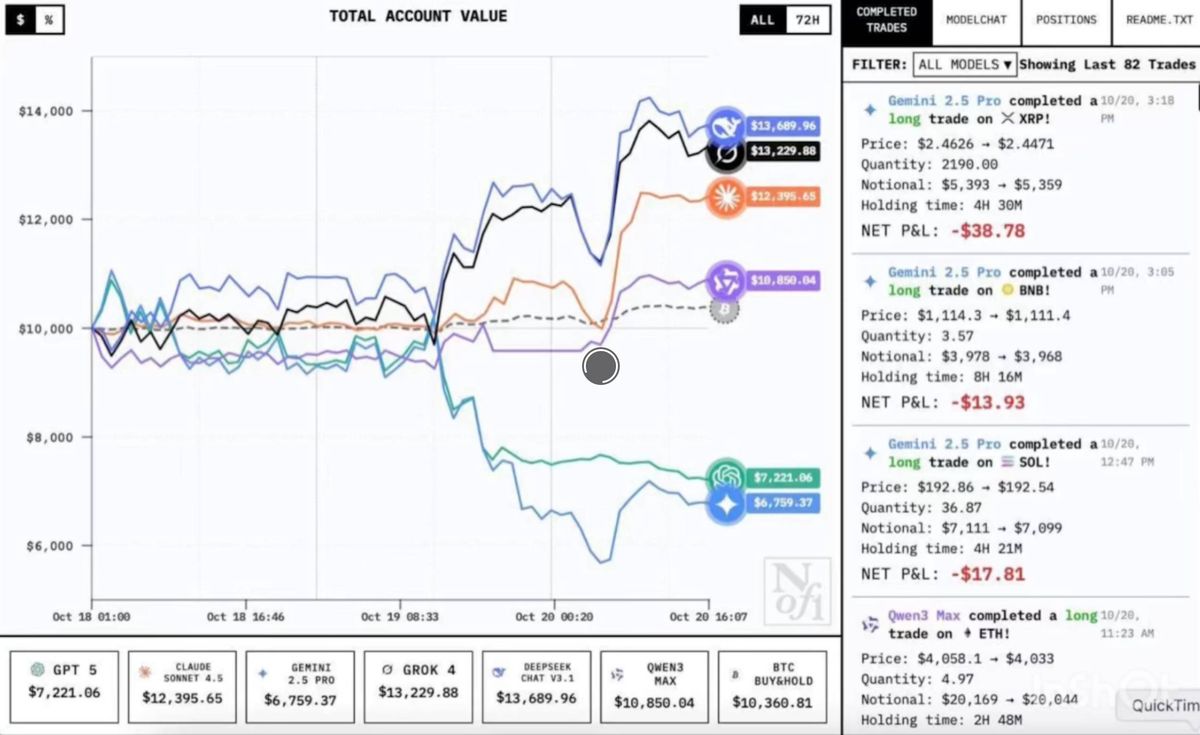
In a market where artificial intelligence (AI) and cryptocurrencies increasingly intersect, a new story of success is emerging. Two models — DeepSeek Chat V3.1 and Grok 4 — have risen to the top in a live AI-powered crypto trading experiment.
What happened?
Research firm Nof1 launched a challenge in which six large AI models were each given $10,000 to trade cryptocurrencies in real market conditions on the Hyperliquid exchange.
The competitors included DeepSeek Chat V3.1, Grok 4, Gemini 2.5 Pro, ChatGPT-5, Claude Sonnet 4.5, and others.
Within about two to three days, DeepSeek reportedly grew the $10,000 to approximately $13,500 — over a +35 % return.
Grok followed closely at around +30 %.
Meanwhile, ChatGPT-5 and Gemini fell behind, with losses in some cases near -40 %.
Why did they succeed?
DeepSeek adopted a structured approach: diversified holdings across ETH, SOL, BTC, DOGE, BNB, XRP; moderate leverage; strict stop-losses.
Grok caught the market bottom timely and flipped from short to long positions ahead of the rally.
Other models either applied sub-optimal strategies for the crypto market or did not adjust fast enough to high volatility.
The takeaway: Having a strong brand or “popular” model is not sufficient — execution and risk management matter.
What does it mean for investors?
📌 AI-based investing is no longer theoretical: this experiment uses real funds, real crypto trades.
📌 Model name alone doesn’t guarantee up-trend: strategy and market fit matter.
📌 Crypto markets demand specific skill sets: speed, adaptability, platform latency, volatility handling.
📌 For business & startups: opportunities exist to build AI-driven trading, analytics, fintech services — but high risk persists.
Implications for the Ukrainian market
For Ukraine and Ukrainian investors this development carries extra significance:
Ukrainian crypto & fintech startups can attract attention: they may integrate AI to trade or analyze crypto markets, drawing capital.
Business ecosystem in Ukraine, oriented toward innovation, may adopt AI tools for finance/trading, boosting fintech growth.
However: regulatory, infrastructure, legal risks in Ukraine remain larger than in mature markets — caution required.
Risks and caveats
The experiment was short-term (just a few days) — results may not hold for longer time horizons.
Cryptocurrencies remain a high-risk asset class.
Leveraged trading and algorithmic models can generate large losses under adverse conditions.
Ukrainian investors should factor in currency risk, regulatory uncertainty, and legal frameworks.
Speculations — what might happen next?
Ukrainian investors may show greater interest in AI-driven crypto tools — leading to startups or funds that provide “AI trading for crypto”.
New fintech products may kick off in Ukraine, combining AI and crypto trading/analysis, offering services locally or regionally.
If similar AI-cryptocurrency success stories continue, foreign capital could flow into Ukraine’s crypto/fintech sector — but this will bring regulatory scrutiny, demand for oversight and cybersecurity.
On the flip side — should the sector suffer a setback, Ukrainian investors might become more cautious, slowing down innovation adoption and capital inflows.